
Solution Step 1 : Speech Realignment
In Step 1, we focus on introducing a continuous flow of speech by realigning the default speech mechanism. This involves synchronizing your natural speech pattern with your internal body rhythm and other associated factors through specific actions and activities.
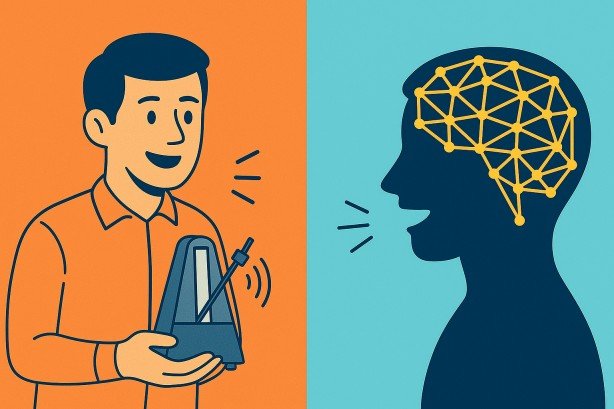
In Step 1, we focus on introducing a continuous flow of speech by realigning the default speech mechanism. This involves synchronizing your natural speech pattern with your internal body rhythm and other associated factors through specific actions and activities.
In neuroscience, there is a term called Brain plasticity OR Neuroplasticity, which refers to the brain’s ability to rewire itself. You can form new neural circuits by doing specific related activates.
Our approach introduces a subconscious frame of reference into your natural speech patterns: your internal body rhythm. This rhythm subtly directs when to start, pause, and stop, creating a smoother, more controlled speech flow. When a blockage happens, people often freeze for a few seconds, not knowing what to do. That moment is what we call stammering. It happens to everyone occasionally, but for you, it’s simply become the default setting your speech system runs on. This subconscious frame of reference replaces that struggle with a natural cue – like rewiring your internal play-pause button – so your speech keeps moving without conscious effort.
How can we realign the default speech mechanism?
Introduce one activity in your day to day routine, which involves below points :
- An activity that requires coordination between the body and brain in Timing.
- It demands rhythm sense, dynamics, motor skills and engagement of muscle memory.
- Something new for your body and brain that isn’t part of your usual routine.
- An activity that is accessible and allows you to practice for at least 30 mins a day.
Formula : Mechanical Activity + Timing + Talking
You can practice your communication and speech through any activity that you can do it in specific timing. While there’s no exact way to measure your rhythm sense, some people naturally have it, and others may need to develop it. Improving your rhythm sense simultaneously realigns your speech and communication, which is why while doing these activities : talking or even just counting beats is important. Below are some examples of activities to help you get started
- Playing a musical instrument
- Dancing & Movement Rhythm
- Rhythm-Based Exercise & Workouts
- Walking to a beat & Tapping exercises
- Typing with rhythm
- And Anything that you can do in timing
How to Practice :
You can practice any basic day-to-day activities in a steady beat help train your internal rhythm. When you combine these activities with talking or counting beats aloud, your rhythm sense strengthens.
- Use our specially designed “Advanced metronome“ is free, easy to use and accessible from any device and unique complex time signatures.
- Begin at 60 BPM and practice with multiple time signatures and syncopation exercises.
- Syncopation exercises means playing different rhythms with each hand — for example if you are playing piano or simple taping exercises, the left hand plays 1 beat while the right hand plays 2, 3 or 4 beats, different combination and reverse etc. (search syncopation exercises on internet)
- Most importantly, practice speaking with rhythm – whether it’s a paragraph, a simple sentence, or even counting beats aloud, clearly, and with good articulation.
- Experiment with various subdivisions across different time signatures and focus on specific beat positions.
- Configure complex polyrhythm sequences using all the metronome’s advanced features.
Unlock your rhythmic potential with this versatile practice tool!
If you don’t have anything specific in mind :
here’s a simple hack :
- Imagine a circular disk like object spinning steadily in your mind.
- Start practicing speaking or talking in sync with metronome rhythm and disk’s circular movement.
- Gradually speed up or slow down the disk, accordingly adjust your pace of speech to match.
- Keep speaking without stopping until the disk stops – this will add a frame of reference, adjust play/pause mechanism and helps overcome the blank, stuck feeling.
- Also you can take small tally counter and press the counter based on rhythm, concentrate on moving disk, speech of rhythm and talk while doing this. Here, you’re talking while pressing your hands on the counter, checking the disk movement, and aligning your speech – a form of multitasking in rhythm, which is the most important part.
- Simply put, stammering is all about 80% related to how you start a sentence. So, when you begin speaking, imagine a rotating disk starting in your mind – this will act as a Kickstarter to get your speech flowing.
- Try more complex rhythms like compound rhythms or polyrhythms. With consistent practice, your brain will become habit and build new neural pathways to improve speech flow.
- Once it becomes a habit, you won’t need to do it consciously anymore.
The best way to begin, in my view, is by learning a musical instrument.
Training Objective : Neuroscience perspective
We are targeting 2 things,
1 : Disrupted Timing Sensors :
This is one key pattern we observed during neuroimaging analysis. Practicing this activity helps improve and align your default speech mechanism with your body’s internal rhythm. After several months of practice (around 4-5 months), I personally observed clear functional differences in my own brain imaging. For children, these changes can often be noticed much earlier. The key is to keep talking while practicing, allowing the rhythm to gradually sink into your body.
2 : Brain Activation :
By practicing multiple tasks, motor skills, dynamics in rhythm and timing, we allow different brain regions to activate and gradually synchronize with our communication. In this way, we provide the brain with a stable frame of reference. Over time, it has been observed that the overactivation in the right hemisphere reduces to a small but meaningful degree, while other regions begin to engage more effectively – helping to fill that functional gap through these activities.
Initial Stage
Disrupted Timing Networks
No Data Found
After 6 month
Disrupted Timing Networks
No Data Found
Initial Stage
Activation Patterns
No Data Found
After 6 month
Activation Patterns - Improvement
No Data Found
Neuroscience perspective
As someone who was a severe stammerer, I personally experienced significant improvement through practicing music instrument and in that rhythm-based exercises. Inspired by this, we extended the approach to an internal research community study involving over 85 participants.
Using functional MRI (fMRI) and diffusion tensor imaging (DTI), I tracked my own brain activity and that of a few internal members over a 6-month to 2-year period.
Because of limited resources, it was not possible to track many people. However, through specific manual sampling and experience-based analysis, we found that structural changes were less visible and less common, but we definitely observed clear trends in functional changes.
More granular information is available in technical paper.
These neurofunctional changes correlated with measurable improvements in speech fluency and motor coordination, supporting the hypothesis that rhythmic training can induce neuroplastic adaptations in timing-related neural pathways critical for speech production.
My Experience & Proof of Concept
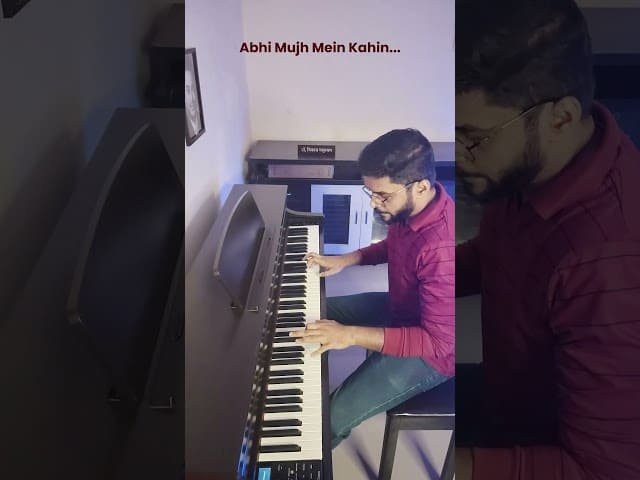
I never had any such interest until 2019, when I began playing instrument solely as part of this solution – step 1. I started with string instruments and later took up piano in 2021, which demands complex motor skills – using both hands independently, coordinating 3 foot pedals and playing melody and bass simultaneously.
For me, this step was the key contributor in my journey. I have also seen similar progress in others. Below are some video to show you how serious I was at the start and how this journey later grew into a genuine hobby. I run a website and YouTube channel called IndiPiano.com.
This is my experience, you can explore and discover your own special activity. The key here is since you are investing time and effort, choose something that not only helps realign your default speech mechanism but also becomes an additional skill or asset in your life.
Conclusion and What’s Next
The Step 1 – speech realignment program, especially through timing and rhythm exercises, has the power to transform speech fluency by rewiring the brain’s natural timing mechanisms. My personal journey, supported by research and practical results, shows how dedication and the right tools can lead to lasting improvement.
Wishing you strength and success and All the best on your path to smoother, more confident speech!
I look forward to seeing you in Step 2 and 3, where we will dive deeper into advanced techniques to further enhance your fluency.



 You can report directly via our Contact Form or email us at below emails.